The Glass Tower Myth: Why New Buildings Do Not All Look Alike
Glass towers differ in structure, façade rhythm and street detail. Learn what to look for so a reflective surface does not hide a building’s design.
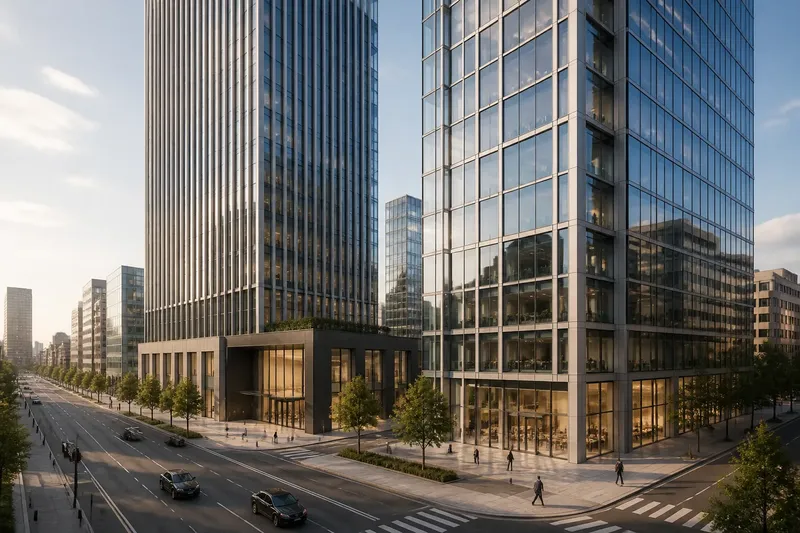
Glass towers do not all look alike: their frames, façade patterns and street-level choices give each building a different character. Stand across the road and compare the spacing of the vertical lines, the depth of the entrance and the way the upper floors meet the sky. The reflective surface is only one part of what you see.
Glass is a surface, not a whole design
A glazed façade is the outer layer of a building, not a description of its entire construction. Behind it may be a structural frame, floor plates, lifts, stairs and enclosed rooms. The glass can sit in front of that structure, fit between its members or form part of a more complex assembly.
This distinction matters because a façade can make a building appear lighter, smoother or more uniform than its underlying arrangement. Reflections shift with cloud, sun and neighbouring buildings; the lines of the frame remain more stable. Look for those lines before judging the building by its changing colour.
Think of glass as wrapping paper around a parcel: it affects what you see, but it does not tell you how the contents are arranged. The analogy has limits, since a façade also controls daylight, weather protection and the building’s outward appearance. Still, it helps separate the visible finish from the system behind it.
Structure sets the building’s basic rhythm
Tall buildings need a structure that carries floors and resists forces such as wind. That structure might use columns, walls, a central core or a combination. Its position and spacing affect where openings can sit and how the elevation is divided.
From the pavement, scan for repeated vertical members and horizontal floor lines. A regular grid may read as a calm sequence, while a strong central core or widely spaced supports can produce larger areas of uninterrupted glazing. Some structural elements are visible outside; others are concealed behind cladding, so appearance alone cannot settle exactly how the building is built.
Notice how the pattern changes as the tower rises. A building may have a broad base, a narrower upper portion or a crown that gathers its lines into a different arrangement. These shifts can reflect structural needs, interior uses or the designer’s composition rather than a simple choice of glass colour.
Façade rhythm makes similar materials look different
Two buildings can use comparable glass and still have sharply different elevations. Rhythm comes from the repeat and interruption of bays, windows, fins, balconies, spandrel panels and opaque sections. A tight grid gives the eye many small intervals; broad panes and fewer divisions make the face feel more continuous.
Depth also changes the reading. Recessed windows cast shadows, projecting fins catch light, and set-back terraces interrupt a flat plane. At a distance, these details may merge into broad bands. Near the entrance, they become easier to distinguish, so view the building from more than one position if you can.
Colour is only one cue. Glass may look blue, grey or almost black because of coatings, interior shading, reflected sky or nearby surfaces. Compare its edges and joints instead: the way panels meet and the way opaque bands cross the windows often reveal the intended pattern more clearly.
The base tells you how a tower meets the street
A tower’s relationship with the street is not decided by its upper floors alone. The base may contain shops, a lobby, a sheltered entrance, blank service areas or a change in scale that connects the tall mass to nearby buildings. These choices affect what a pedestrian encounters at close range.
Look at where doors face, whether windows reveal occupied rooms and how the building edge meets the pavement. A transparent lobby can still feel closed if it has no visible entrance or activity. Conversely, solid stone, brick or metal at street level can create a clear, tactile edge without making the whole building feel withdrawn.
Materials often vary by zone. A heavier-looking base may support a more open upper façade; a canopy or recessed doorway can mark the threshold. These changes give the building a legible beginning, rather than letting its glass face descend unchanged to the pavement.
How can you read a glass tower from the street?
What should I look at first?
Start with the building’s outline and its largest divisions: base, middle and top. Then follow a column line or window bay upwards to see whether the pattern stays regular or changes.
Why does the glass change colour?
Glass reflects its surroundings as well as transmitting light, so its appearance shifts with the sky, angle of view and interior conditions. Compare the same elevation from another position before treating a colour change as a different material.
Can I tell how a tower is supported?
You can identify visible clues, such as external braces, regular columns or a strong central core, but a finished façade can conceal much of the structure. Treat a street-level reading as an informed observation, not a full account of the engineering.
Does a transparent façade always feel open?
No. The entrance, ground-floor use, lighting and relationship to the pavement all affect whether the building feels welcoming. Glazing may reveal a lobby while still leaving the street edge inactive.
Use a short comparison to see the differences
Say you are comparing two newly built towers on the same block. One has closely spaced vertical fins, a recessed lobby and a broad solid band near its base; the other has larger panes, a visible external frame and doors opening directly onto the pavement. Both may be described as glass buildings, yet their different rhythms, depth and street edges are immediately observable.
For a quick comparison, note the outline, the spacing of façade divisions, any changes in depth, the materials at street level and the placement of entrances. These observations help explain what distinguishes the buildings without assuming that a reflective finish makes them interchangeable.
The next time a glass tower seems anonymous, move closer to its base and trace one visible line up the elevation. The detail that separates it from its neighbour may be a shadowed recess, a structural bay or the way the entrance addresses the pavement—not the colour of the glass.