A Rainy-Day Walk Along a Transit Corridor
A rainy-day walk along a transit corridor reveals how stops, crossings, shopfronts and sheltered edges connect, helping you read the street as a sequence.
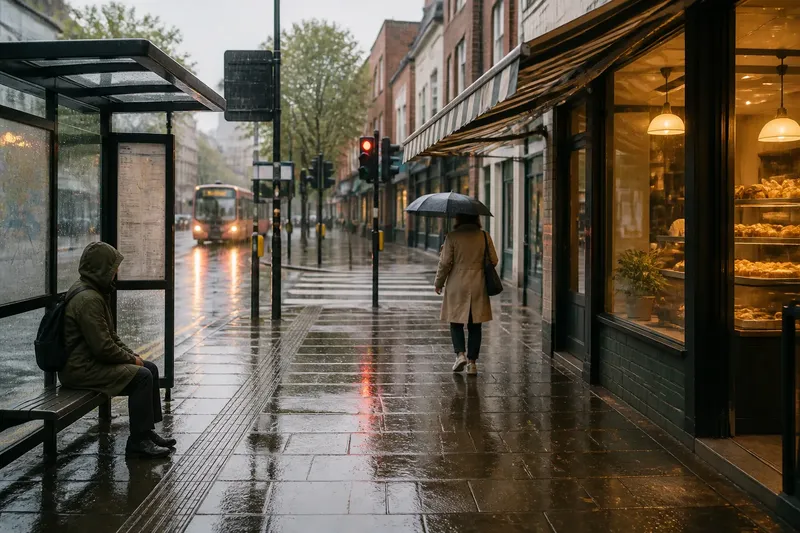
A rainy-day walk along a transit corridor shows whether its stops, crossings, shopfronts and sheltered edges form a useful sequence or a set of isolated points. Choose one stretch served by transit, walk it at an ordinary pace, and notice where rain changes your choices: where you pause, cross, turn towards a shopfront or seek cover. The aim is to read how the corridor works on foot, not to find the quickest route.
Rain makes small connections visible. A shelter may protect the waiting area but leave the approach exposed; a shop awning may help pedestrians yet stop short of the crossing. Treat the street like a sentence: each stop and sheltered edge is a phrase, and the gaps between them determine whether the whole thing reads smoothly.
Choose the walk that fits your purpose
Start by deciding what you want to understand. Keep the observation narrow enough to remember details, and broad enough to see how the parts relate.
- If you are studying a stop: begin at the transit platform or stop pole and walk to the nearest crossing and shopfronts. This fits a question about whether people can arrive, wait and continue on foot without losing shelter or orientation.
- If you are studying a crossing: start on one pavement, cross at the signal or marked crossing, then continue to the next stop. This suits a corridor where the central issue is whether the crossing connects destinations on both sides or leaves one side feeling cut off.
- If you are studying a shopping stretch: walk from one active shopfront to the next, noting where awnings, recessed doors or arcades offer cover. Choose this when the question is how everyday frontage supports walking and waiting, rather than how the transit service operates.
- If you are studying continuity: follow a short stretch from stop to stop, but pay attention to the edges between them. This is useful when the individual places seem adequate yet the walk feels exposed or disjointed.
Use the same starting point and direction if you return in different weather. You do not need a formal survey sheet; a pocket notebook or a simple sketch can capture the sequence. Record what you can see and do, not assumptions about why a feature was designed that way.
Read the corridor as linked thresholds
A transit corridor is not just a line of stops. It is a succession of thresholds: leaving a vehicle, finding the pavement, approaching a crossing, passing a doorway and reaching a place to wait. Rain reveals where one threshold hands you on to the next.
At a stop, look beyond the shelter itself. Is there space to step aside without blocking people walking past? Can you see the crossing or the next useful destination from where you wait? Does water run off the roof onto the boarding area or collect near the kerb? Note the physical condition you observe without assuming how often it occurs.
Then follow the edges. A canopy, awning, arcade or deep doorway can extend shelter, but only for part of the walk. Notice whether these cover points line up with the stop and crossing, or whether a bare gap separates them. A short exposed section may matter more to the experience than a large sheltered area that is hard to reach.
Pay attention to transitions rather than judging each feature alone. A bench can make a waiting place more useful, while its position may narrow the path. A shop entrance can offer a sheltered recess, but a door swing or display may interrupt the walking line. Describe the trade-off as a relationship between features, not a verdict on one object.
Choose what to notice in different conditions
Rain is not one condition. Drizzle, steady rain and a shower after a dry spell can change what the street reveals. Choose observations that fit the weather and avoid treating one visit as a complete account.
- In light rain, follow sightlines. Notice whether a waiting passenger can see an approaching vehicle, a crossing signal or a recognisable shopfront without moving into the walking flow.
- In steady rain, follow cover. Track where a person can stay dry while moving from the stop towards the crossing or nearby entrance. Mark every point where the cover ends.
- After rain, follow the ground. Look for puddles, wet leaves, slippery-looking paving or water draining across a walking line. Record locations, not claims about surface safety.
- In wind-driven rain, follow the exposed side. Compare the sheltered building edge with the open pavement. A canopy may cover the pavement from above yet offer little protection from rain blowing sideways.
Keep the observation respectful and ordinary. Do not photograph identifiable people without permission, and do not stand where you obstruct boarding, entrances or the pavement. If conditions make a crossing or walking surface feel unsafe, stop the observation and return another time.
Keep a useful record without turning it into a route plan
Draw a simple line for the corridor and add symbols for stops, crossings, shopfronts and covered edges. Use a different mark for gaps where there is no visible shelter. Beside each mark, write a short note about what the rain changes: waiting, visibility, passing, entering or crossing.
Separate observation from interpretation. “Awning ends before the crossing” is an observation. “The crossing is poorly designed” is a judgement that needs more context. You might later compare visits, ask local users about their experience or check the street’s design information; for this walk, keep your notes grounded in what you can see.
Say you begin at a bus stop beside a bakery and walk towards a signal crossing in steady rain. You notice the shelter covers the bench, the bakery awning continues along the pavement, and both end before the crossing. In your sketch, mark the dry waiting area, the covered shopfront and the exposed gap; the expected observable result is a clear record of where shelter connects and where it breaks, without claiming how every passer-by experiences it.
If the corridor changes character at a side street, note the point rather than extending the walk automatically. A junction can redirect foot traffic, interrupt awnings or bring a new stop into view. Keeping the boundary clear helps you compare the same stretch later.
Which part should you follow first?
Should I start at the stop or the crossing?
Start at the stop if you want to understand waiting, boarding and the first steps away from transit. Start at the crossing if the question is how people move between the two sides of the corridor.
What should I record if there is no shelter?
Record the exposed approach, any nearby doorway or awning, and whether those edges are accessible without entering a private space. The absence of a shelter is one observation; the surrounding options explain how the corridor supports or fails to support a pause.
How can I tell whether a shopfront helps the walk?
Notice whether its awning or recess actually covers a public walking or waiting area, and whether doors, signs or displays leave room to pass. Describe what the frontage changes on the pavement rather than guessing what the owner intended.
Should I revisit the same corridor?
Return if weather, time of day or transit activity is likely to alter what you are observing. Keep the same stretch and direction, then note what changed; a second visit adds context without turning the walk into a comparison of unrelated streets.
Use the notes to describe a real connection
At the end, write one sentence about the strongest link you noticed and one about the clearest break. For example, the stop may connect well to a covered shopfront but poorly to the crossing, or the crossing may be easy to see yet exposed from the waiting area. Those statements are more useful than calling the whole corridor welcoming or unfriendly.
A rainy-day walk along a transit corridor is most revealing when it follows one question from threshold to threshold. Your notes can help residents, designers or local groups discuss a specific gap: where cover stops, where the walking line narrows, or where a crossing sits apart from a place to wait. Keep the sketch and its limits together, so a reader can see both what you observed and what remains unknown.